
You Have a Prototype, Is That the Same as What You Will Get in Mass Production?
A prototype (confirming a design) is not the same as mass production. The gap between the two depends heavily on how the sample was made, who made it, and the production method. That gap can widen if a proper design for manufacturing review was never done in the beginning.
The Exciting, Misleading Milestone
Once an idea has been sanity checked, and a concept drawing has been through a DFM review, the next step is usually a prototype. This is often the most exciting part of the whole process, seeing your idea in three dimensions for the first time.
But what does that prototype tell you about what you will get once the order goes into mass production? If you are working directly with a factory to save cost, you will often be sent a prototype to approve with no explanation or risk assessment attached, and no clear information on how the product may differ once it scales. If no DFM was conducted before the sample was built, those variations can be large.
Why Cut and Sew Prototypes Lie to You
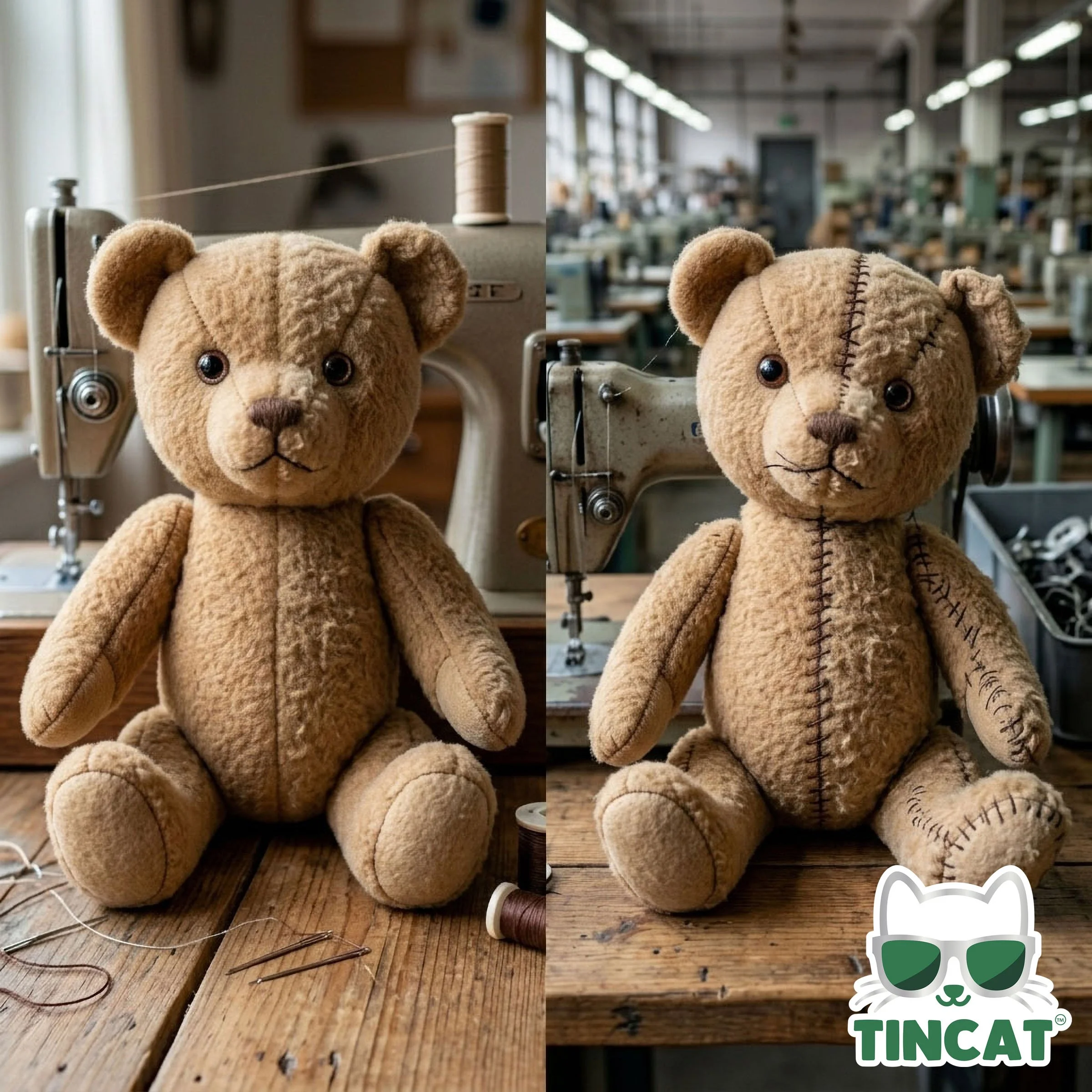
With cut and sew products, garments or plush toys, the sample is typically made in a sample room by one person who has spent years training specifically as a prototyper. Good prototypers are highly sought after in China, because that first sample is often what wins them the mass production order. Your prototype will be close to spec and will look like the character it is based on because one highly skilled person made every decision on every seam.
Mass production does not work that way. Every stitch line is done by a different person, and the components move through a line where the final stuffing goes in and the last stitch closes it up. The person stitching the arm has no visibility into how their tolerance affects the finished product further down the line. There are design choices that can minimise this risk, but even then, variation in production basically guaranteed.
Why a Model Cannot Tell You About Durability or Part Lines
A second example is durability testing on a resin model. A prototype model will typically be broken by Standards testing or running it through use and abuse tests. A model usually has different part lines (where the tool opens) and joins to what the injection moulded version will have. A 3D printed prototype may have no part lines or joinery points at all, because it was printed as one solid piece.
That means the prototype you are holding may not have the seams, joints, or structural strength the real production part will have, but all of which can be assessed and explained by a holistic product developer.
The Sticker That Cost a Week
A third pattern, and a major and completely avoidable source of delay, is a client making minor tweaks to a finished sample that are already well within normal production tolerance. Moving a sticker a few millimetres on a box so it is perfectly centred, and running another full round of sampling to prove it, is a time waster. Stuck on by hand in mass production, that sticker was always going to carry more variance than the change requested.
Lab Dips and the Fifty Percent Rule
One of the biggest time wasters we see in apparel is the ‘lab dip’. This is where a factory provides a lab-produced fabric swatch for colour approval before the fabric is dyed at scale. We have seen a project where eleven lab dips were requested to get a colour exactly right. The problem is that a lab dip is only ever a colour produced in a lab, and the actual dyed fabric is likely to land a shade off regardless of how many rounds you run.
Our rule of thumb when approving lab dips: if the next requested change is 50% likely to overshoot than land closer to the target colour, approve the current dip colour with comments and move on.
“If the next change is 50% as likely to overshoot than land closer...approve the current labdip colour”
At some point, reality has to set in. You need to get the product to market, and there will always be some variability once it reaches production.
Why the Second Approval Sample Should Never Be Another Lab Dip
The purpose of a lab dip, or a pre-production sample in hard goods, is to create an agreed reference point between you and the factory. Both sides sign off on it, understanding the allowance built in for normal production tolerance. Once that reference exists and the first production run has shipped, its job is done.
The mistake we see constantly is a client asking for a fresh lab dip or a new PPS for the second production run. It feels like the safe, careful option but is the opposite. Requesting a new sample resets the matching exercise, sending you back into the same hit and miss process the first run already worked through. Except now you are trying to match a lab sample again instead of matching what you already have shipping to customers.
Don't resample on the second run. Use previous production samples as your reference for the reorder.
The better reference for a second run is a sample pulled from the first production run itself. It was made on the actual line so a factory can copy it more easily than it can a lab dip. It also keeps your two production runs aligned with each other, rather than each one separately, and imperfectly, chasing the different lab references.
Expert Insight
"A prototype answers one question well: does the concept work as intended," says the Tincat team. "It rarely answers the question people actually treat it as answering, which is whether mass production will deliver an identical result. Those are two different questions, made by two very different processes, and mixing them up is where a lot of avoidable delay and disappointment comes from."
What This Means for Your Product
Treat a prototype as confirmation of concept, not confirmation of the mass production outcome. Understand which process made your specific sample, and ask, ‘what tolerance and variation will mass production introduces once it scales?’. And know when a tweak is chasing a level of precision your production method will never actually hold, because that is where timelines blow out.
Get a prototype review that tells you what will actually change once your product goes into mass production. Contact Tincat
Frequently Asked Questions
-
A: A prototype is often made by a single highly skilled person, or by a process like three-dimensional printing that behaves nothing like the mass production method. Mass production splits the work across many hands or introduces joinery and part lines the prototype never had, which is where the real variation comes from.
-
A: Fewer than most people assume. Once a change is as likely to move further from the target as closer to it, further rounds are wasting time rather than improving the outcome. Understanding your production method's real tolerance up front avoids chasing precision it was never going to deliver anyway.
Written by the Tincat Team