
Great Idea, Now What? Why Commerciality Has to Be Checked Before You Design
Checking commerciality at the idea stage means confirming a product can be manufactured, priced, and sold before any real design work begins. It matters because a brilliant solution to a real problem can still fail completely if nobody checked whether it could be built and sold at a price the market will pay.
Solving the Problem Is Not the Same as a Viable Product
Many inventors and entrepreneurs are laser focused on solving the issue in front of them. It is a genuine strength, that focus is usually what got them the idea in the first place. But on its own, it is incomplete. Without a step back to look at the commercial reality of the product, it is entirely possible to spend months, and real money, designing a solution that is technically excellent and commercially unviable.
The fix is asking the right questions before the solution is even fully resolved, not after. Can this hit the price point it needs to? Has the problem already been solved?
Do the Research Before You Do the Design
Before anything gets drawn up, look at how the problem is being solved right now, in the real world. Who is fixing this problem already, and how? Is there a way to improve on it, provide more value, or simplify something that is currently over-engineered? A good idea is to buy the existing solution and actually use it. What are the ergonomics like? Is it intuitive? What would you change?
Ask 'How is this problem being solved in the real world now?'
And if you genuinely cannot find anyone solving this problem at all, ask the harder question: is it a problem worth solving commercially, or is that the reason nobody has solved it yet? Remember there are thousands of product designers and developers, including plenty already working in the industry your solution is aimed at, all trying to find the next new thing. If the gap looks too easy, it is worth checking why.
Talk to a Holistic Product Developer Early
This is the point to bring in a product developer who can look at the whole picture, not just the sketch. A good one will guide you on how to shape the concept, flag whether it can be manufactured and what issues it might run into, suggest materials, and, if they are any good, offer improvements across multiple parts of the product you had not even considered yet.
Prepare an Early Budget, Before You Put Pen to Paper
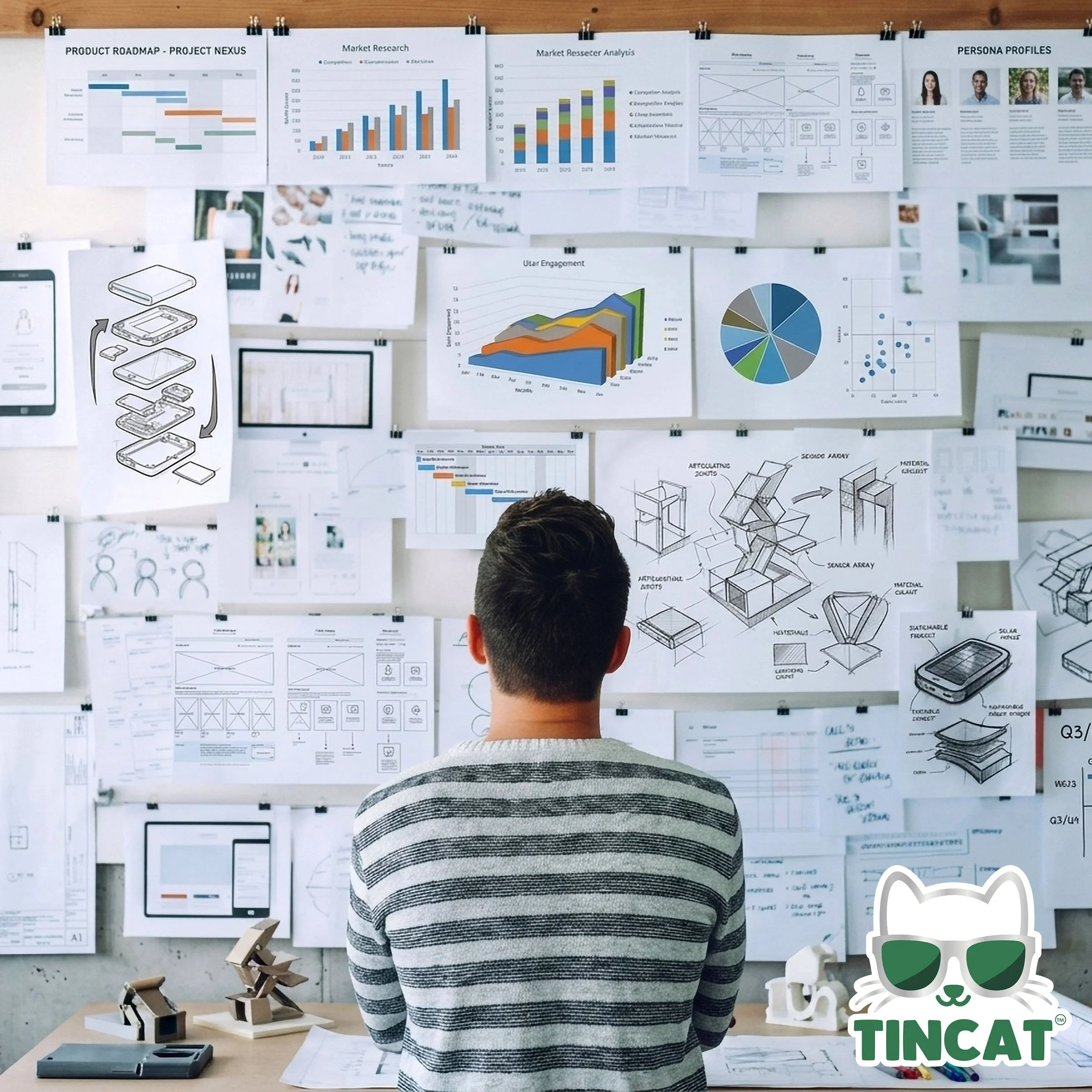
Yes, even before the product is designed. A good product developer can give you a rough cost estimate and help you work out what that looks like as a retail price point, and whether that fits your target RRP. From just the idea alone, before you have spent a dollar, they can also give you a rough project cost including the minimum order quantities, or MOQs, you are likely to face, so you know roughly how much stock you would need to commit to.
Drawing up a concept without any understanding of mass production, manufacturing methods, or target pricing can waste thousands of dollars and produce a concept that simply is not functional as a business. The real disaster is when the entrepreneur, or their customer, falls in love with that concept, or anchors their expectations around the sketch, only to be told afterwards that it cannot be done anywhere near the price it needs to hit.
Getting Rough Pricing on a Sketch, Early
Tincat can generate rough pricing straight off a sketch, and use that number to modify the concept early, while it is still cheap to change, rather than after everyone is emotionally attached to it. We also understand materials and finishes, and their real limitations, well enough to give early advice that aligns your expectations of the finish with the price point you are trying to hit.
The Table Sports Game That Never Got Illustrated
Tincat worked with a client on a genuinely great new table sports game idea. It got knocked out at the idea review stage, not because the concept was bad, but because the client had not done the market research to see what already existed. They pushed ahead anyway with some differentiation ideas, and a rough project costing came back well outside their budget.
That simple check, done before a single illustration or brand asset was created, saved them thousands of dollars they would otherwise have spent developing a product that was never going to go ahead.
A simple concept review can save you thousands of hours and dollars.
Expert Insight
"The founders who protect their money best are not the ones with the best idea," says the Tincat team. "They are the ones willing to get a sanity check on that idea before they fall in love with it. A rough cost estimate and a quick look at the competitive landscape, done early, costs almost nothing compared with what it saves. It either confirms you are onto something, or it saves you from spending real money finding out the hard way."
What This Means for Your Idea
Before you commission a sketch or a render, do the competitor research yourself. Talk to a holistic product developer about manufacturability and materials. Get a rough budget, including MOQs, against your target RRP. Treat all of this as a sanity check on the idea itself, not a delay to it.
Get a rough cost and a manufacturability sanity check on your idea before you spend a dollar designing it. Contact Tincat
Frequently Asked Questions
-
A: There is no such thing as too early. A rough estimate straight off a sketch, or even a description of the idea, is enough to flag whether you are in the right range for your target RRP, before you spend money on illustration, branding, or detailed design.
-
A: That can mean a genuine gap in the market, but it can also mean the problem is not commercially viable to solve, given how many product developers across many industries are already looking for exactly that gap. Research into why no solution exists is just as important as researching how existing solutions work.
Written by the Tincat Team