
Balancing the Triangle: The Three Pressures on Product Development
The Iron Triangle of product development is the balance between specifications, cost, and time, and the principle that you can usually optimise for two of the three, but rarely all three at once. Understanding how the pressure between them shifts across a project is one of the most useful, and most overlooked, skills a product developer can have.
Good, Cheap, Fast: Pick Two
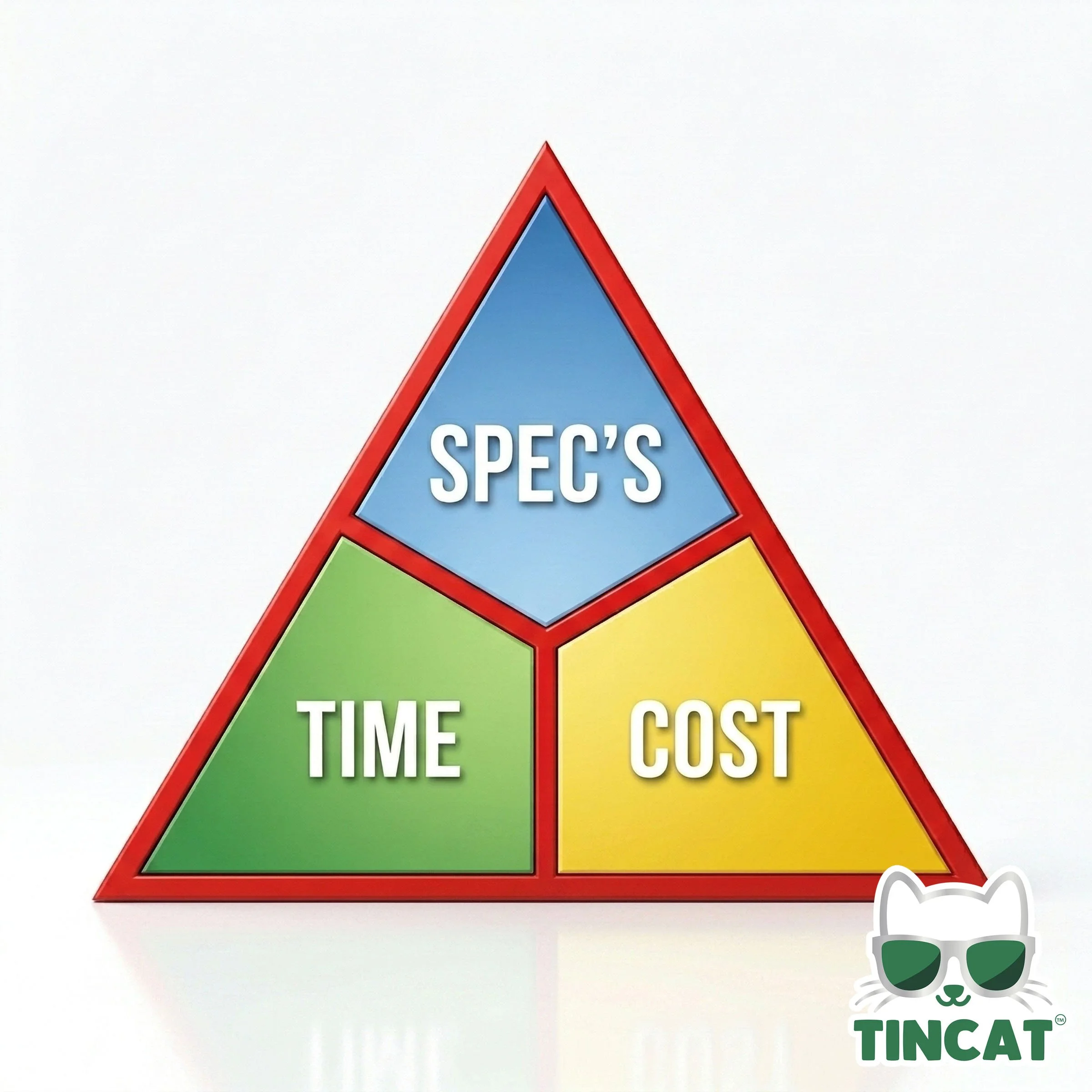
This is not a new problem. It has been attributed to John Ruskin in the 19th Century that you can have two of the three qualities, good, cheap, or fast, but rarely all three together. If you had an unlimited budget, getting high specifications and quality in a short amount of time would be simple. If you did not care how something was made, you could get it cheap and fast. But in the real world, a product developer has to hold all three in balance at once, and that balance is never static.
The Pressure Moves, and Most Teams Do Not Notice
Here is what is not always understood: the pressure from stakeholders on each of the three points changes as the project moves through its stages.
Early on, a product is developed to satisfy a need, and nearly all the pressure sits on specifications. It feels like there is plenty of time and there is no product to price. So, the concept and the specs go back and forth, tinkering with every iteration, and as more people get pulled into development, more opinions arrive, and more changes follow them.
Then the product is almost ready, and it is time to show some customers. What does it cost? Almost always, the multiple rounds of iteration and addition have pushed the product well past what the customer is willing to pay. Now the pressure shifts to cost. Negotiations happen, small changes get made to the design under duress, and all the while, the clock is still running. Someone mentions the time. "That is fine," comes the answer, "we just have to get this right."
Once specifications and price finally land within tolerance, the design goes to the production manager, who looks at it and says there is not enough time left to make it. Now the pressure is on time, and the stakeholder with a launch date says, ‘it simply must be done.’
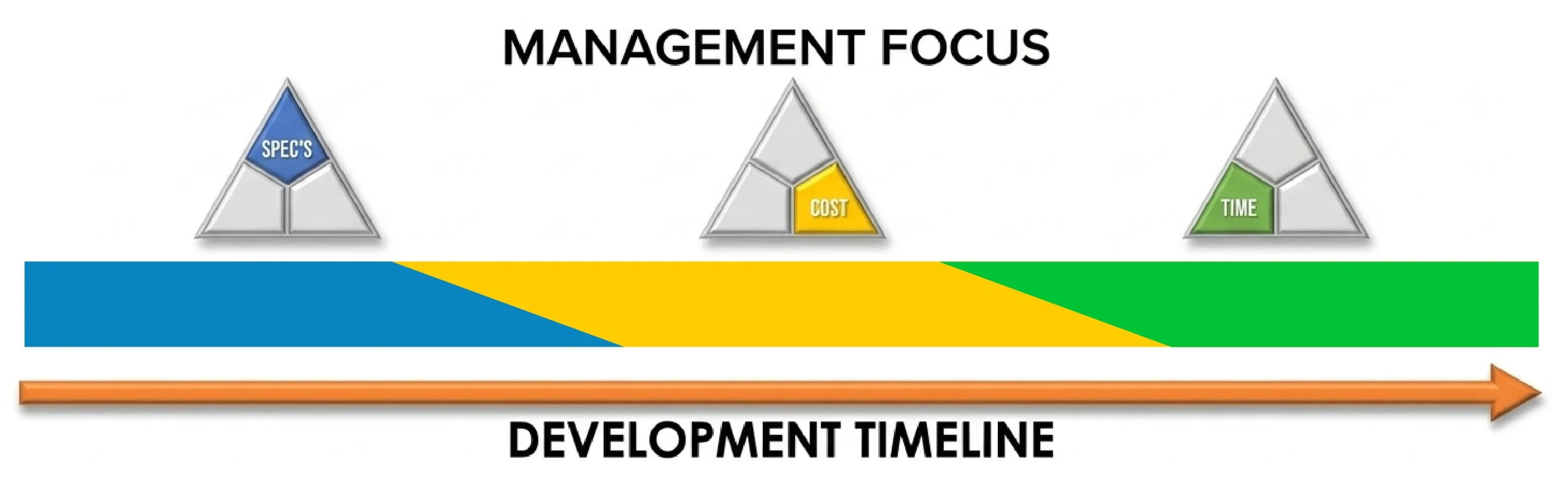
The end of the story is familiar to almost anyone who has run a physical product to market: quality issues from a rushed production run (blown specs), and an enormous airfreight bill (blown cost) to hit a deadline that should never have been this tight in the first place!
Stage Gates Help, But They Have a Weak Point
Modern project management has an answer to this: Stage Gates. A set amount of time is allocated to get the best possible specifications, and at that point, the Gate closes and the specs lock, no more tinkering. Then a set period is spent working purely on price, with minimal further changes to specs, before the next Gate. This theoretically leaves enough time for production and shipping, which is so often the one squeezed by slippage earlier in the process.
Stage Gates work, until the moment a stakeholder asks for one more change after the Gate has already closed, because the customer just requested something new. The system only holds as long as everyone respects the Gate, and in practice, that is exactly where it tends to break down.
The Better Fix: Holistic Development From the Start
A stronger approach is holistic product development from day one. Specs and pricing should not flow one after the other in a straight line, they should be worked on together, starting from the idea stage. Project plans should be drawn up and agreed at the very start, not assembled reactively once something has already slipped.
Having a rough idea of cost early does real work here too. It stops runaway iteration in its tracks, because you can show a stakeholder exactly what their requested change does to the price, in the moment they ask for it, not three months later.
Version control matters just as much. A prototype that is ‘good and selling’ beats a ‘best version sitting on the drawing table’. Further ideas and refinements can be shelved for version two,
“Further ideas and refinements can be shelved for version 2”
rather than delaying version one indefinitely in pursuit of a perfect specification nobody has tested with a paying customer yet.
Expert Insight
"The Iron Triangle does not go away just because you manage it well," says the Tincat team. "What changes is who is fighting for control of it, and when. A professional product development agency gives you a genuine third party in that conversation, someone who can hold the balance across specs, cost, and time without getting pulled into the internal politics that so often decide which aspect gets sacrificed. Being across the product holistically, from idea to shipping, is what lets us keep an eye on all three points at once, rather than reacting to whichever one is loudest that week."
What This Means for Your Product
Decide your project plan, and a rough cost target, at the idea stage, not after the specs have already run away from you. Whenever a stakeholder requests a change, show them the cost and time impact immediately, not at the next review. And treat "good and selling" as the actual goal for version one, saving further refinement for version two rather than letting it hold your launch hostage.
Get a product developer who manages the balance between specs, cost, and time from day one, not just when one of them is already in crisis. Contact Tincat
Frequently Asked Questions
-
A: Rarely, and usually only when a business is willing to accept a real trade-off elsewhere it has not yet noticed, such as absorbing a cost overrun quietly or accepting a lower specification than originally intended. Genuine balance across all three at once is uncommon enough that assuming it is achievable is itself a risk.
-
A: They help significantly by forcing a decision and locking it in, but they rely on everyone respecting the gate once it closes. The moment a stakeholder pushes a new change through after a gate has locked, the same tension the gate was designed to prevent comes straight back.
Written by the Tincat Team