
‘Norms’ are the specific, unspoken operating rules that sit underneath culture, governing how a factory floor or overseas office behaves day-to-day rather than what its national culture theoretically predicts. They are the fifth, and often most overlooked, barrier to globally distributed teams, sitting alongside temporal, geographical, lingual, and cultural distance.
The Four Barriers Everyone Already Knows
Founders working across borders are usually warned about four barriers early on.
Temporal, the time zone separation that shrinks the window for real-time collaboration and delays every feedback loop.
Geographical, the physical distance that removes face-to-face contact, body language, and the ability to just walk over and check something.
Lingual, the language differences that create literal translation gaps, even when everyone involved is technically speaking the same second language.
Cultural, the broad, deep value systems (such as individualism versus collectivism, or attitudes to hierarchy and time), that shape communication styles and social expectations.

These four are real, well documented, and worth understanding. They are also not the whole story.
Why Culture Is a Poor Predictor at the Individual Level
Cultural differences are well documented, and founders are often encouraged to lean on them to interpret how an interaction with a factory will go. The problem is that this is a very broad view. The recognised culture in Australia or America says very little about how any one individual within it will behave. Likewise, national culture is a poor predictor of how a specific factory, or a specific manager within that factory, will respond in a specific situation.
What is worse, believing you understand cultural differences well enough to use them as the key to unlocking factory responses can cause dangerous misinterpretations. You are applying a broad-strokes framework to a narrow, individual interaction, and mistaking ‘confidence in the framework’ for ‘accuracy about the person’.
Culture
#
individual
The Fifth Barrier: Norms
What is usually missing is the recognition of norms, the specific, unspoken operating rules underneath culture. Two factories in the same country, operating within the same broad national culture, can have completely different norms.
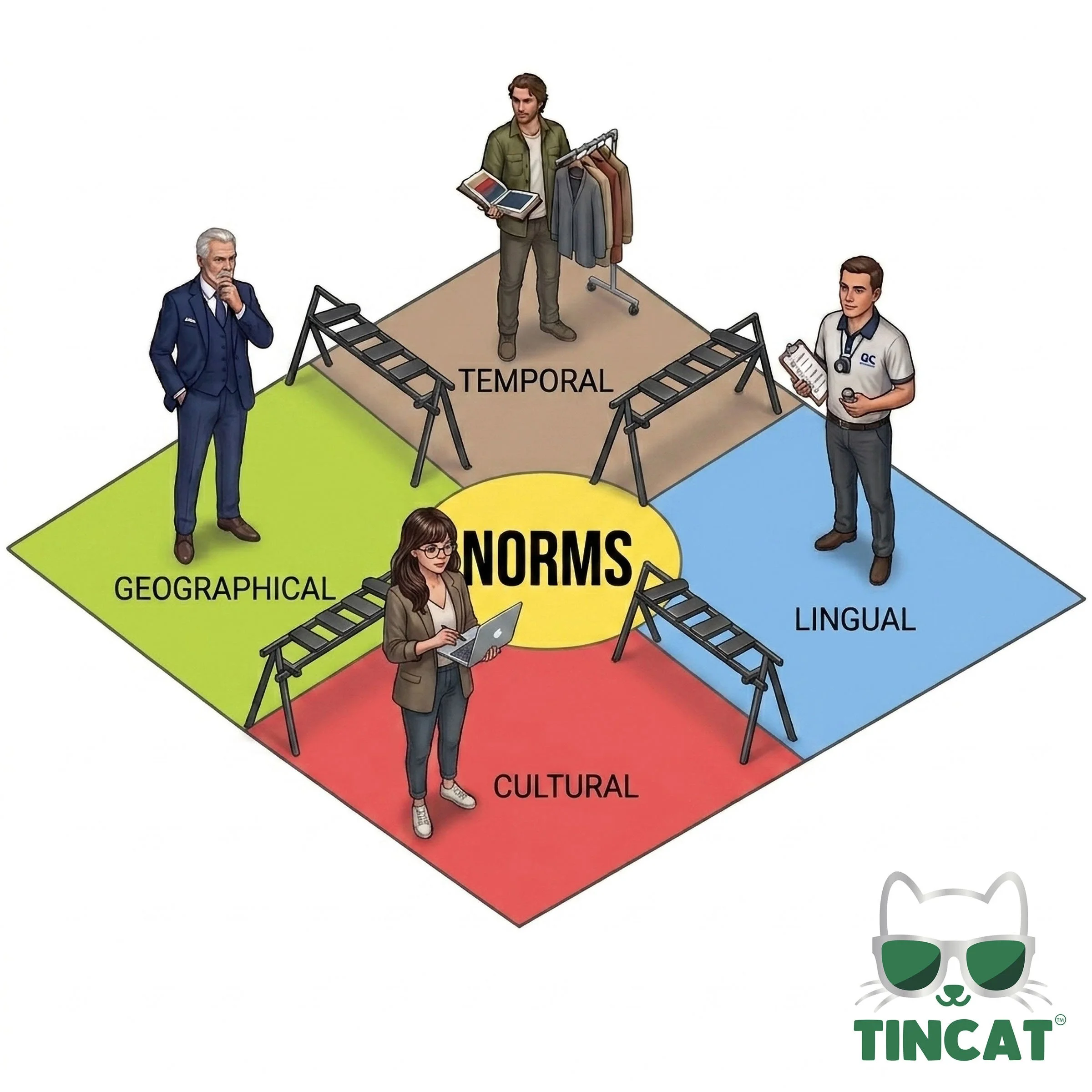
These can include whether instructions are challenged or simply followed when something looks wrong, whether "yes" means genuine agreement or simply "I heard you", and whether raising an issue outside the business is seen as constructive problem-solving or as a breach of factory protocol.
How Norms Get Mistaken for the Other Four
Norms are not just confused with culture, they cloud the other three barriers as well. Silence on a video call while discussing an issue might be read as guilt or evasion. It could just as easily mean the geographical barrier is hiding a team working on a solution just off camera, or the language barrier means the person is translating your question into their own language, and their answer back into yours before they speak.
Because norms are not universal, treating every difference as a cultural difference, and then being surprised it did not conform, steadily erodes trust. And it resets every time a new factory is onboarded, since norms change at the individual factory level.
This is not limited to customer-to-factory interactions either. It happens inside companies with offices in different countries. Norms in each office grow organically and diverge over time and, without deliberate attention, this can breed mistrust and the false assumption that another office is simply bad at its job, when the real issue is that nobody ever aligned on how each office actually operates.
Tincat's Four-Part Solution
This is a solvable problem. Time can help but solving it through years of trial and error is slower than most factory relationships or launch timelines allow. Tincat proactively approaches it in four ways.
Map the norms early, and agree on them. With an on-the-ground presence in the factories, our staff can identify norm differences quickly and align them before they cause friction. We document norms the same way we document product specs, which means this knowledge survives staff turnover rather than living in one person's head.
Build in structured, explicit checkpoints. Organic issue escalation may simply not be a norm on the other side, so we agree on checkpoints and escalation protocols early, rather than assuming a factory will proactively flag a problem the way you might expect.
Use visual overlays and reference samples over written instructions. As covered in our piece on ending the sample revision loop, these sidestep language barriers and, just as importantly, act as a norm-neutral communication method that does not rely on either side correctly reading the other's unspoken rules.
Keep multilingual staff embedded in-market. Our teams build genuine, ongoing relationships with specific factories, which means they can identify a factory's norms quickly, and just as importantly, identify how those norms differ the moment a new factory is onboarded.
Expert Insight
"The four recognised barriers get most of the attention because they are visible and easy to name," says the Tincat team. "Norms are harder to spot precisely because they hide inside the other four. A silence gets blamed on culture when it was really a language delay. A missed escalation gets blamed on distance when it was really a factory's unspoken rule about who is allowed to raise a problem. Reducing the other four barriers to zero is what lets norms surface clearly enough to actually be discussed and compensated for, before they erode communication and trust."
What This Means for Your Business
Before you attribute a confusing factory interaction purely to culture, ask whether it might actually be a norm, specific to that factory, that has nothing to do with its national background. Document the operating norms of each supplier relationship the way you would document a spec sheet, so the knowledge does not disappear if a key staff member moves on. And treat visual, norm-neutral communication as a genuine risk-reduction tool, not just a convenience.
Get a partner who maps the norms behind your supplier relationships, not just the culture. Contact Tincat
Frequently Asked Questions
-
A: Culture describes broad, national-level values that theoretically apply across an entire population. Norms are specific, unspoken operating rules that exist at the level of an individual factory, office, or manager, and they can vary significantly even between two organisations within the same national culture.
-
A: No. The same divergence happens inside a single company with offices in different countries. Norms in each office grow independently over time, and without deliberate alignment, this creates the same mistrust and miscommunication seen in factory relationships.
Written by the Tincat Team