
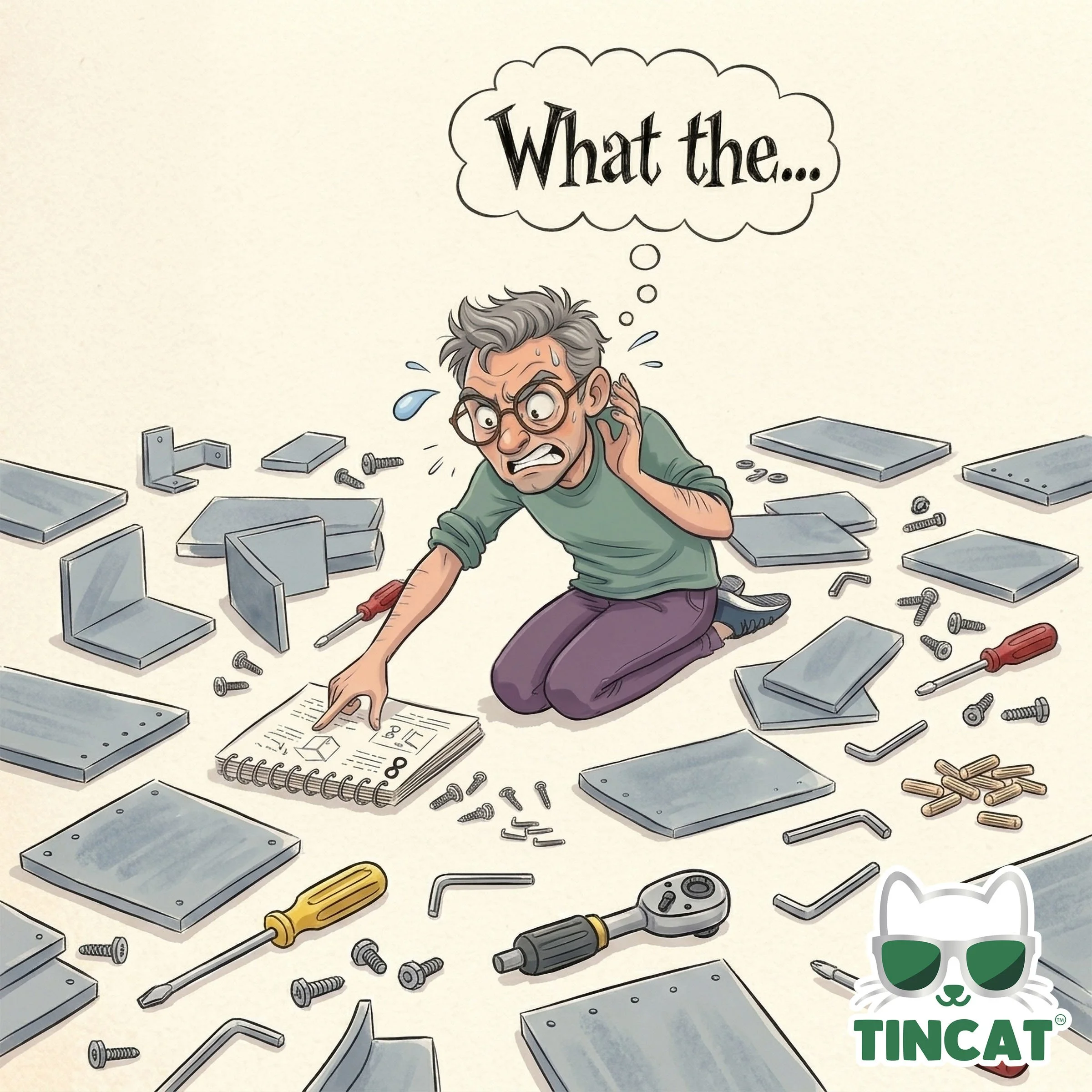
Instruction and assembly presentation is the design discipline of guiding a customer from opening the box to fully using a product, in an ergonomic way. It matters because a poorly instructed product frustrates the customer and generates returns and one-star reviews for reasons that have nothing to do with the product itself.
Nothing Is Wrong With the Product
You have bought a self-assembly product, spent two hours on it, and realised you missed two steps back near the start. Pull it apart and start again, or give up and send it back in frustration. Often there is nothing wrong with the product at all. The gap is between what the customer expected, what the product actually does, and whether the instructions helped them close that gap in their own home, on their own timeline, without any of the context the manufacturer already has in their head.
Instructions are usually written last, and usually by someone who knows the product too well to write for someone who has never seen it before. That mismatch is the whole problem in miniature.
Instructions are usually written last and by someone who knows the product too well.
Instructions Are Your Last Chance Advertising
Instructions deserve the same seriousness as packaging, because modern psychology shows the last part of an interaction is often what solidifies a customer's overall opinion of a product. A brand can nail the shelf appeal, deliver a great unboxing moment, and still lose the customer at the finish line if the instructions are confusing or poorly constructed.
At best, a bad instruction booklet means a customer misses features they paid for. At worst, it means frustration, a one-star review, and returns, on a product that would have performed perfectly well if the customer had simply understood it.
What the Board Game Industry Can Teach Hardware Brands
Cross-industry experience is often where the best fixes come from, and one industry that has had to solve instructional clarity almost perfectly is board games. Communicating complex rules to a brand-new player, with zero prior context, is exactly the same problem as communicating a hardware product to a first-time user. Tincat has a background in board game rules writing, and we apply that same structure to product instructions.
The Four-Part Structure That Actually Works
>
Orientation
comes first. Give the customer an overview of the product and its components, so they can get their bearings and see, at a glance, what success looks like before they touch a single part.
>
Basic operation
comes next. Cover the functions a customer is most likely to use first, turning the product on, adjusting the basics, the core function, in a clear section with visuals that follow the same order the product is used. In board games, this is the starter rules, the simplest version of play before any of the optional complexity is introduced.
>
Higher functions
follow. This is where additional features belong, laid out not by what the feature is, but by the benefit it gives the customer. A setting is not interesting on its own. What that setting lets someone do is what earns their attention.
>
Troubleshooting and FAQ
close the structure. This section gives you a second chance to rephrase anything that may have been misunderstood the first time, and it is one of the most critical sections for avoiding returns, because it catches confusion before a customer's frustration turns into a refund request.
The Forgotten Step: Focus Testing
Even a well-structured set of instructions is not finished until it has been tested on someone who has never used the product. Game designers spend months playtesting rules with new players precisely to catch confusion the designer cannot see anymore, because they know the game too well. Assembly instructions deserve the same discipline, and it does not need to be expensive to do.
A useful shortcut is filming a factory worker who has never seen the product before, following the instructions exactly as written. Watch where they hesitate, where they misread a step, or where they do something the instructions never anticipated. That footage tells you far more than another internal review ever will.
On one outdoor sports product requiring assembly, this exact process revealed that the biggest point of confusion was connecting the poles correctly. The fix was simple: coloured stickers on the poles themselves, matched and called out directly in the instructions. Retested, it worked perfectly. A small change that can be the difference between frustration and genuine excitement through assembly.
Expert Insight
"The instructions are the last thing most teams think about, and the first thing a frustrated customer blames," says the Tincat team. "A product that is genuinely well engineered can still earn a one-star review if the person opening the box could not follow what came with it. Filming someone unfamiliar with the product using the instructions for the first time is one of the cheapest, highest-value tests you can run before you go to print."
What This Means for Your Product
Do not leave instructions until the final stage of development, and do not let the person who knows the product best write them alone. Structure them in the order a first-time user actually needs, orientation, basic operation, higher functions, troubleshooting. Then film someone unfamiliar with the product following them exactly as written, before you commit to print.
Get instructions and assembly guides designed around your first-time user, tested before you print. Contact Tincat
Frequently Asked Questions
-
A: Not the person who designed the product alone. That person knows too much context a first-time user does not have. The best instructions are written or reviewed by someone deliberately unfamiliar with the product, then tested on someone equally unfamiliar with it.
-
A: Very little. Filming a factory worker unfamiliar with the product following the written instructions is one of the cheapest tests in the entire development process, and it routinely catches confusion that no amount of internal review ever would.
Written by the Tincat Team