
Choosing the right supplier means verifying who manufactures your product, not just who answers your enquiry fastest on a sourcing website. It matters because a supplier selected purely on price and responsiveness can turn out to be a trading shell with no domain expertise, no quality control, and no accountability once your deposit has cleared.
The Sirens of Sourcing
Without you having an on-the-ground presence, major sourcing websites look like a simple answer. Cut out the middleman, deal directly with the factory, send out multiple enquiries, and quotes come back fast and cheap. The response was quick, the price was good, the site shows similar products being made, maybe even positive reviews. What could go wrong?
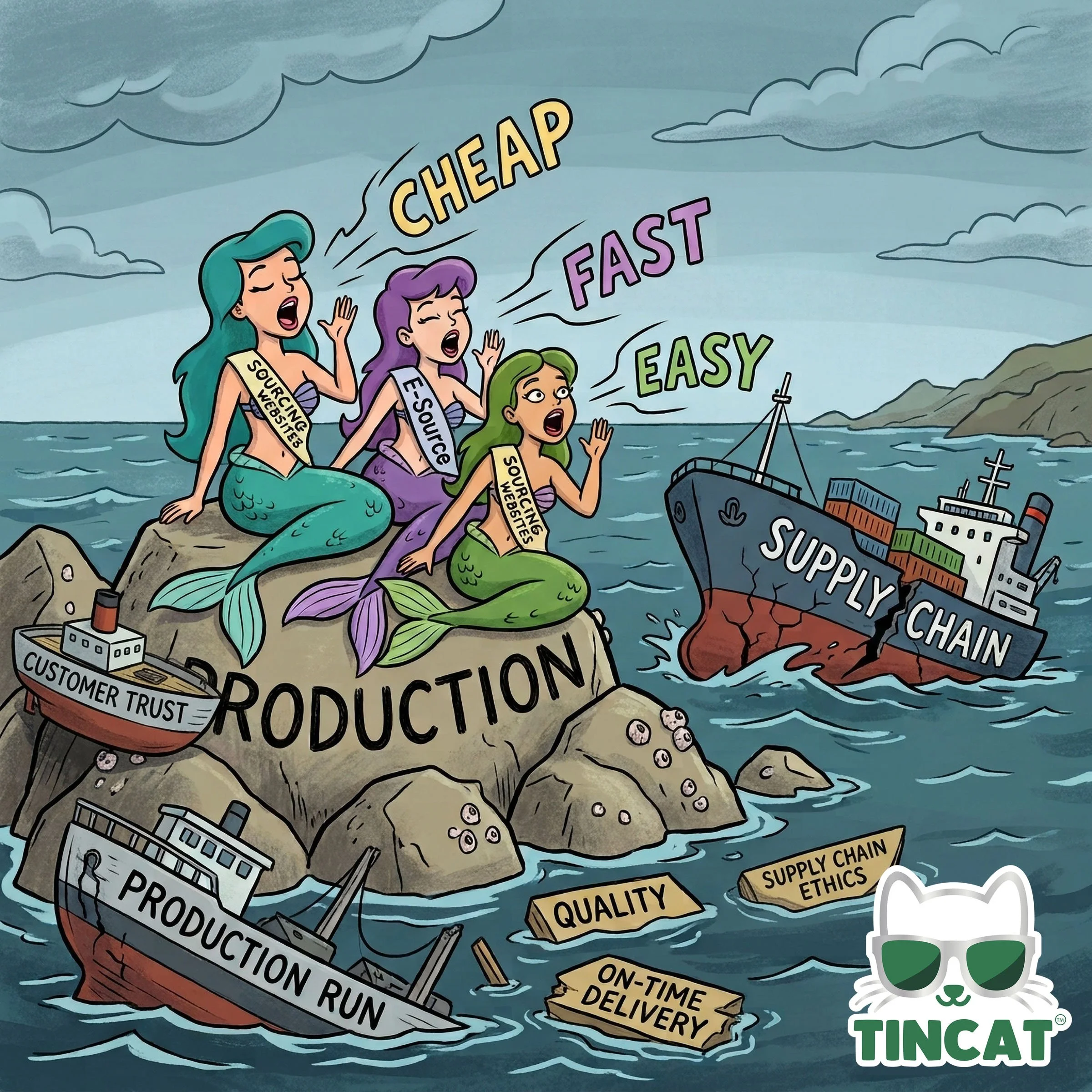
Tincat's largest source of clients are founders who fell into exactly that trap. It is not unlike the Sirens from the Odyssey, saying all the right things until you crash your supply chain like ships on the rocks. And this happens far more often than most founders expect.
Two Types of Companies, and Only One of Them Made Your Product
There are two types of product companies operating in China: trading companies and manufacturing companies. Large, reputable factories run their own in-house trading company purely to handle export, and that export arm works exclusively with its own factory.
The problem is most other trading companies, many professionally listed on major sourcing websites, are not attached to any single factory, despite what their profile claims. They work across multiple factories and are skilled at generating business through excellent customer service. That is also where the risk sits.
Often these traders are little more than a shell name built to win an order. They have no domain expertise, and often shop your order around to other factories. They typically profit on the transactional margin, not the relationship. Some business have multiple ‘trading companies’ working the same sourcing sites with no real business or longevity behind them. They appear, and disappear, after your deposit clears. As a purely online trading operation, they have no inspectors on the ground and no quality control process to control or confirm production. You do not find out there is a problem until it arrives (or doesn’t) at your warehouse.
“you don’t find out if there is a problem until it arrives (or doesn’t) at your warehouse.”
Subcontracting and the Compliance Sharing Trap
Say you were lucky enough to find an actual factory. It is common practice in China for orders to be subcontracted, either because a required part cannot be made in-house, the factory is too busy to take the order, or a smaller factory can produce it more cheaply. The result is that you can’t be certain where your product is being made, or by whom.
This creates a specific danger known as compliance sharing. If you want your factory to be ethical and hold third-party social compliance reports, those reports are almost always issued against the facility, not the trading company you dealt with. A trader may hand you a compliance report that has nothing to do with where your product is really produced. In some cases, a factory will trade under its own name as though the product was made on-site, specifically to make the order look like it came from an ethical, compliant facility.
“Traders routinely use compliance reports from other factories.”
Tincat once visited a factory a client had already chosen to conduct an inspection. It turned out to be a metal folding factory. The plush toys the client had ordered were being subcontracted out entirely, with no visibility into who was actually making them or under what conditions.
What a Real Supplier Review Actually Involves
The risks in offshore manufacturing are significant precisely because the distance between customer and factory makes it easy to get away with. To illustrate what a genuine review should cover, Tincat runs a four-stage review on any potential factory before it enters our network.

Stage two, verify compliance.
We review any third-party social compliance documentation, check it with the auditing company, and run our own basic compliance review to confirm legitimacy.

Stage one, verify the factory is real.
We visit in person and review the business documents to confirm the ‘facility company’ genuinely aligns with the ‘trading company’ presenting it.

Stage three, verify capability.
We review the facility itself, incoming materials control, production lines, and the machinery in use, to determine what the factory can genuinely produce in-house, along with its in-line and final quality control inspection processes.

Stage four, verify subcontracting.
Before quoting, we review any subcontractor the factory intends to use for parts of the product it cannot produce itself.
Beyond onboarding, we run regular performance reviews on every order a factory produces, tracking quality of output, response times, and pricing. Over time, this funnels an enormous pool of factories down to a small, trusted, reliable group we work with regularly.
Expert Insight
"This process is virtually impossible for a single product founder, or for a business moving into a new product category, to replicate on their own," says the Tincat team. "It takes years of on-the-ground visits, documented performance, and relationships with auditors to build a genuinely trusted factory network. Using a company like Tincat means you can be confident in who is actually producing your goods, and in the communication and performance that will come from them."
What This Means for Your Product
Before you commit a deposit to a factory found through a sourcing website, confirm whether you are dealing with the actual manufacturing facility or a trading company sitting in front of it. Ask for compliance documentation issued against the facility name, not just a company name on an invoice. And understand that a fast, cheap, friendly quote is not the same as a verified, capable, accountable supplier.
Get factory vetting built on years of on-the-ground verification, not a sourcing website profile. Contact Tincat
Frequently Asked Questions
-
A: Ask directly whether they are the manufacturing facility or a trading company representing one, and request documentation that names the actual facility. A legitimate factory will not hesitate to confirm this, while a shell trading company will often deflect or provide vague answers.
-
A: Not on its own. Compliance reports are issued against a specific facility, and the danger of compliance sharing means the report you are shown may not relate to where your product is actually produced. Verifying that the facility name on the report matches the facility making your goods is essential.
Written by the Tincat Team