
Building a Realistic Product Development Timeline, Not an Optimistic One
A realistic product development timeline accounts for supplier reliability, product complexity, and review cycles, not just the best-case number on a factory quote. It sits closer to an art built from experience than a fixed formula, and getting it wrong is one of the most common ways a launch date is blown out.
A Quote Is Not a Timeline
A factory tells you tooling will take forty-five days. A modelmaker tells you two weeks. Those numbers are real, but they are also best-case estimates, offered without the context of what could realistically go wrong along the way.
Great to have a number but what is the risk?
“How reliable is this particular supplier, based on their track record, not their sales pitch?
How complex is this specific product, compared with what that factory typically produces?
How much functional information has the supplier been given. Have they actually been given to work from?”
A forty-five day quote against a supplier with a strong history and a simple, fully documented part carries very different risk to the same forty-five days against a new supplier working from an incomplete brief.
See how Tincat manages supplier risk across the full development process
Turning Risk Into Buffer, Without Killing the Project
Once those risk questions are answered, the harder problem starts: converting the answer into an actual buffer on the timeline. Too little buffer and the project runs late from simple optimism. Too much buffer and the timeline becomes so long it kills the commercial case for the project entirely.
There is no universal formula for this. It comes from having managed enough of these timelines, across enough suppliers and product types, to know where the genuine risk sits and where it does not.
The Timeline Steps Nobody Schedules
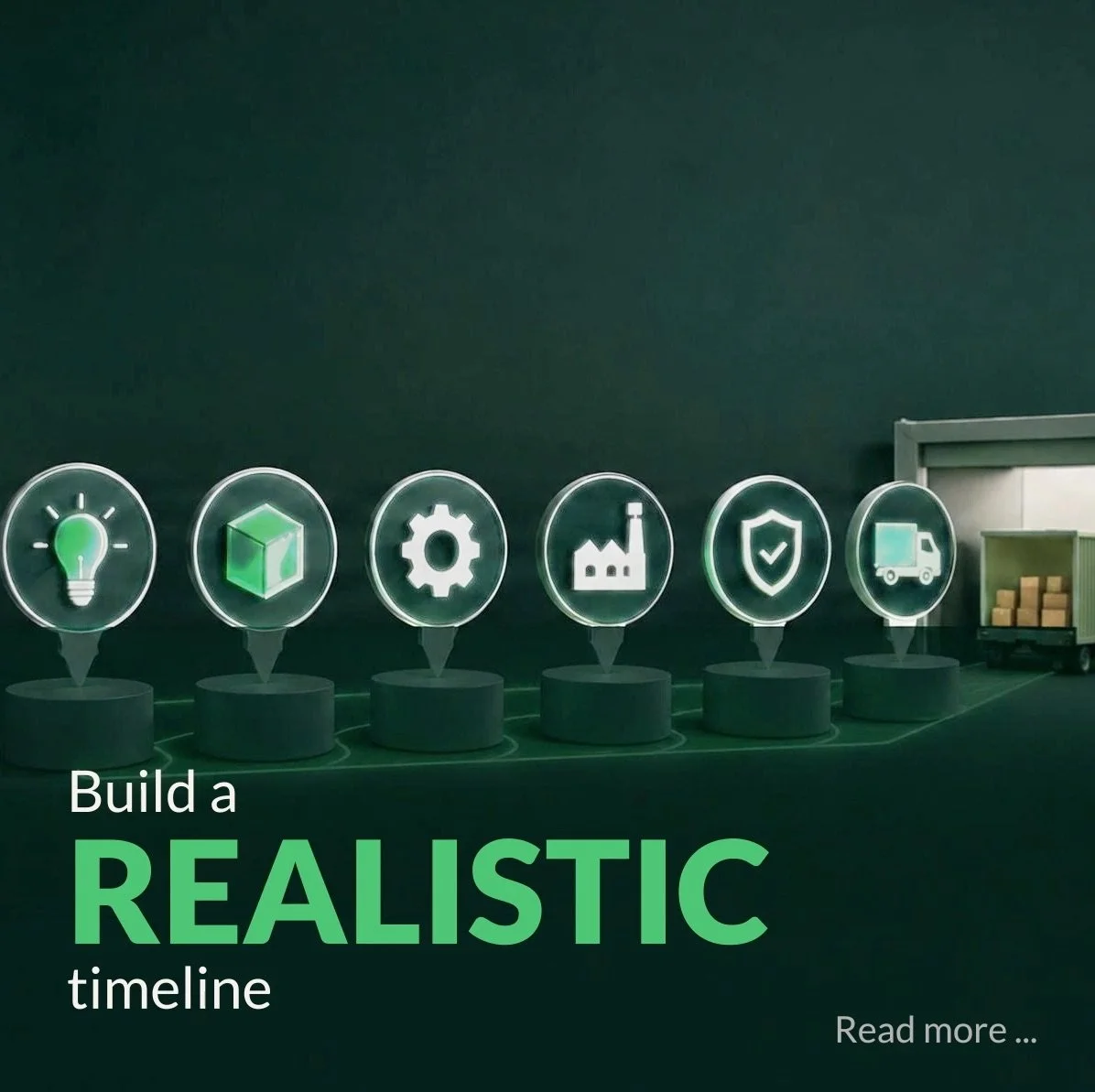
Several of the biggest sources of slippage are not supplier delays at all. They are steps that never made it onto the timeline in the first place.
Shipping and courier time for models and samples moving between factory and stakeholder is often left out entirely, treated as though approval happens the moment a model is finished rather than the moment it physically arrives, assuming it is approved at all.
Review time is another blind spot. How long will the review actually take, and how many people are involved in giving sign-off?
“More reviewers usually means more feedback”
and more feedback usually means more rounds of changes, each with its own turnaround time that also needs to be scheduled, not absorbed into hope.
Learn about Tincat's approach to review and sign-off management
The Question That Breaks Timelines

There is a specific moment that derails more launches than almost anything else. An approval runs a couple of days late. There is already some early timeline slippage. A stakeholder asks the product developer: "Can we still ship on time?".
The problem is the question itself. Can we still ship on time, and will we still ship on time, are two different questions with two different answers. Early in a project, the honest answer to "can" is often still yes, technically. But saying yes to that question, this early, puts enormous pressure on every downstream activity that follows, and that pressure is almost always what actually causes the project to run late.
Beat the Date, Do Not Meet It
A related mistake is treating an internal milestone date as a target to hit exactly, rather than a deadline to beat. If a decision is only considered late once it has actually missed its date, by definition nobody was chasing it before that point.
Time lost this way cannot be recovered. The discipline that prevents it is simple to describe and hard to maintain: treat every internal date as something to beat, not something to meet.
Expert Insight
Timeline slippage rarely looks like slippage while it is happening. There is no single day where a project moves from "on time" to "late." It moves gradually, through a series of individually small delays that each feel manageable in isolation. At Tincat, we spend real time discussing timelines, risk, and buffers directly with stakeholders, using language that reflects that gradual reality rather than false certainty. Phrases like "this is increasing pressure on the timeline," or "the guaranteed date has moved a week, but we are still targeting the original date," give a product developer the ability to manage every stakeholder honestly, without pretending to a certainty that does not exist, and without having to assign blame before the outcome is even known.
What This Means for Your Product
Before you commit to a launch date, ask your suppliers not just how long a step will take, but what could realistically make it take longer, and who is accountable if it does. Schedule shipping, review, and revision time explicitly, rather than assuming they happen instantly. And when a stakeholder asks whether you can still ship on time, answer the question they actually meant to ask, whether you will ship on time.
Get a development timeline built on real supplier risk, not best-case assumptions. Contact Tincat
Frequently Asked Questions
-
A: There is no fixed percentage that works for every project. The right buffer depends on supplier reliability, product complexity, and how much functional detail has already been locked in. Experience managing many timelines across many suppliers is what allows that buffer to be sized accurately, rather than guessed.
-
A: Steps that are never scheduled in the first place, particularly shipping and courier time for samples, and review time for approvals involving multiple stakeholders. These are treated as instantaneous when they are not, and the gap compounds across every stage that follows.
Written by the Tincat Team