
Product vs System: Why "Now What?" Should Be Answered Before You Tool Up
Designing a product versus designing a system is the difference between building a single item and building a foundation that can expand into a range without a full redesign. The choice between the two costs almost nothing to consider at concept stage, but can be much more expensive later on.
The "Now What?" Moment Every Successful Product Hits
A founder develops a product to solve a real-world problem. It works, it launches, and it sells. Then the question that follows every genuine success: now what? Retailers want the next product in the range. Maybe a travel version makes obvious sense.
The problem is that the way the first product was designed, every part moulded specifically for that one item, means none of it can be reused. If product extensions had been considered even briefly at the concept stage, the first product could have been designed with sections that carried straight through into the next one. That is the real difference between developing a product and developing a system.
Systems Are Everywhere, Once You Notice Them
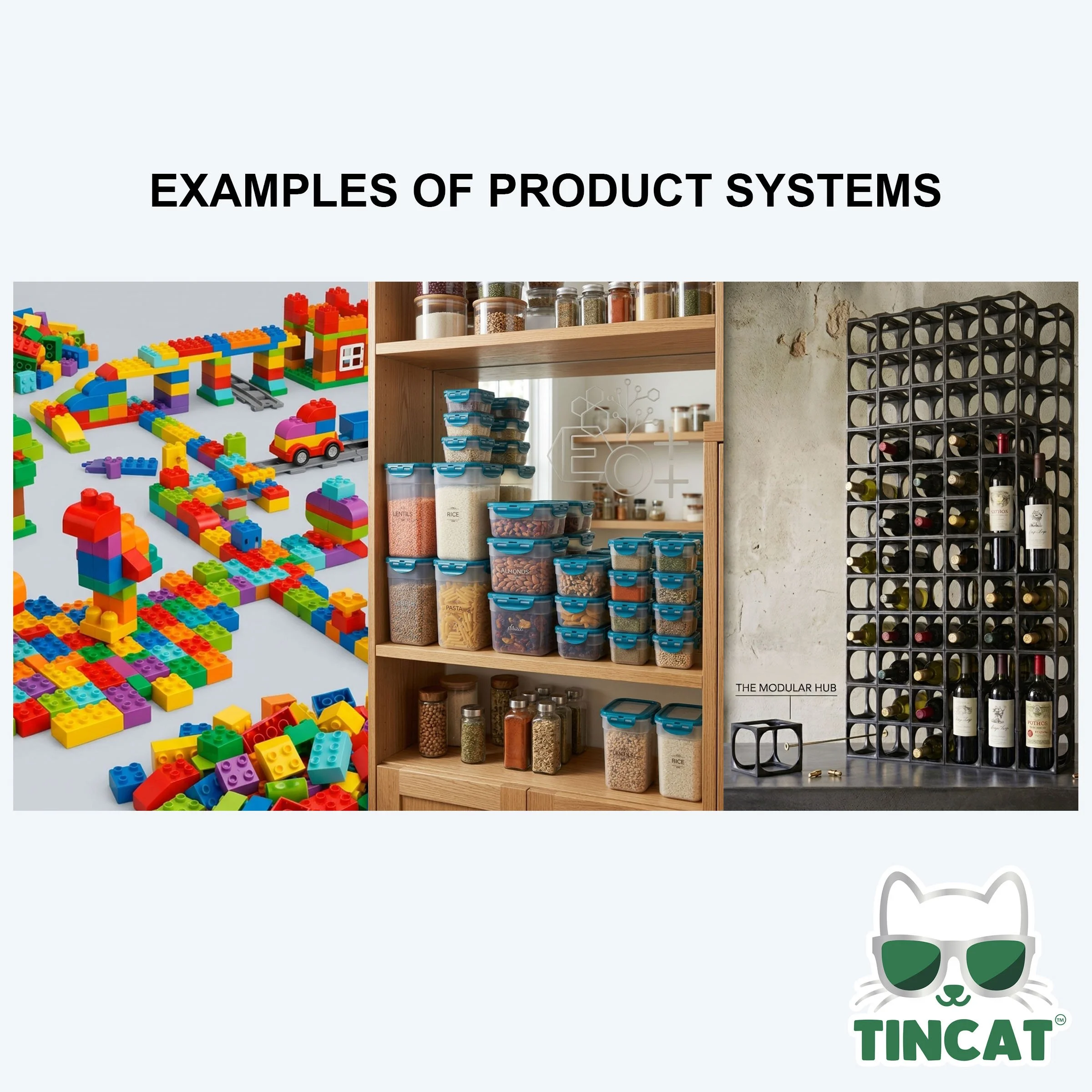
Building bricks, food containers, wine racks, these are all products designed to work within an expandable ecosystem, where adding another piece increases the usability of what you already own. Nobody buys a single building brick. The entire value of the category comes from the system, not the individual piece.
"But my product is a one-off," may well be true. It also does not cost more to consider, and even design in, the ability for a one-off product to become part of a system later, should that ever be needed. The cost of not having it, once a retailer is asking for a range extension, is a redesign.
The Stationery Case That Became a Range
Tincat was approached to develop a storage case for stationery. The original brief was a large, drawer-bound case with specific spaces built for the customer's unique stationery items. It was intended purely as a promotional product, a one-off, with no plans beyond that single case.
During concept review, we identified that the internal spaces could be made both adjustable and removable, for very little additional cost. The customer was dubious, but agreed to the idea.
Months later, the case was a commercial success. Because the core removable spaces already existed, we were able to quickly develop smaller versions and travel versions of the case, using that same system as the foundation.
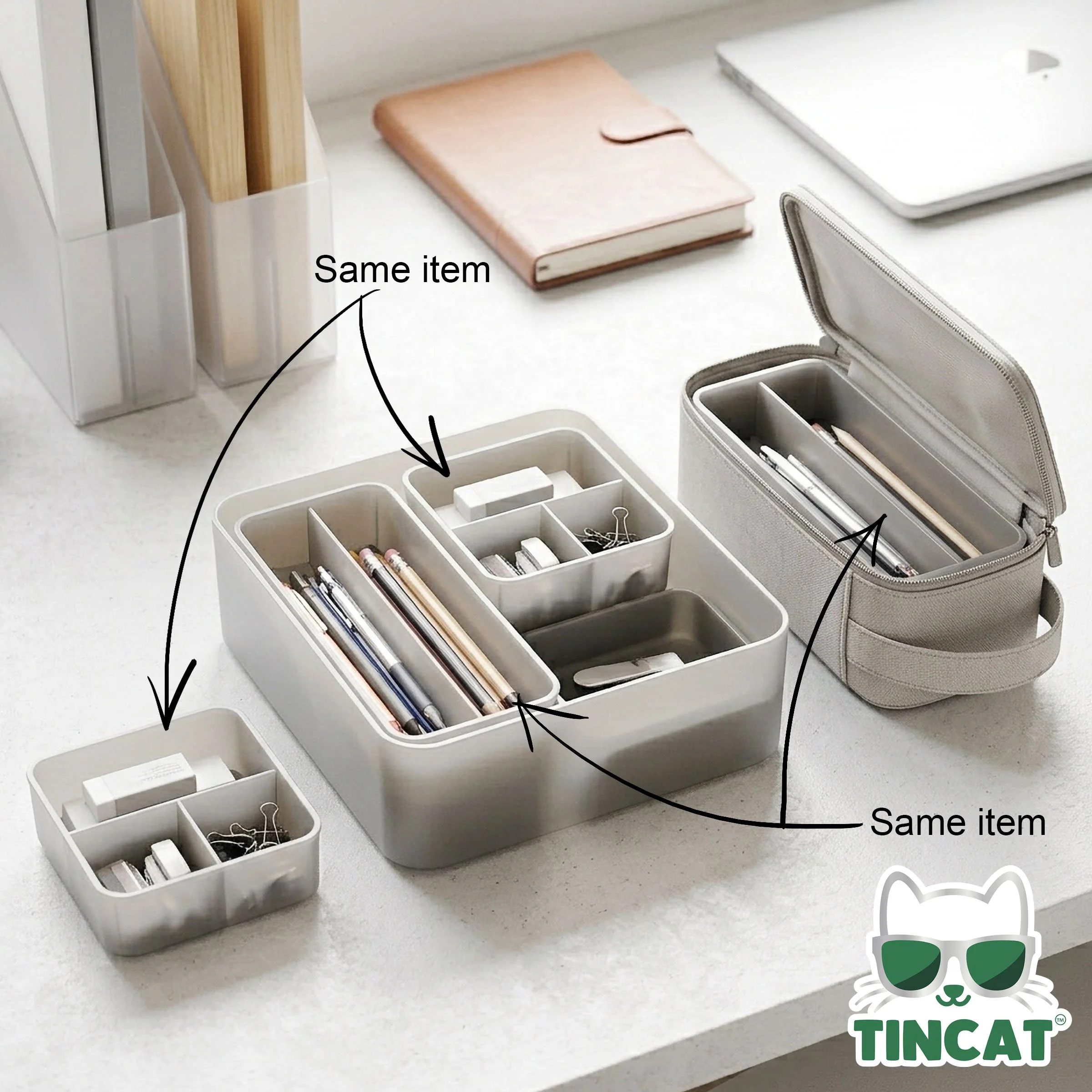
Very little additional tooling was required, and speed to market was dramatically shortened, purely because a product versus system review happened at the concept stage, before anything had been locked into a single-use mould.
Brainstorming Additions That May Never Ship
In other projects, we have made small modifications to a product specifically to allow for future additions brainstormed between us and the client early on. Not all of those additions ever went ahead. That is fine. There was no downside to keeping the option open.
“There was no downside to keeping the option open”
Should any of them go ahead later, the ability to join multiple products together, add a functional accessory, or reconfigure the core feature of the product can be done quickly and without additional retooling, because the groundwork was laid when the cost of doing so was close to zero.
Expert Insight
"The question we ask at concept review is not just what does this product need to do," says the Tincat team. "It is also what might this product need to become. You are not designing for every possible future version, that would be over-engineering. You are just making sure the door is not welded shut on options you have not thought of yet. Most of the time, that costs nothing more than a different approach to a mould split or an internal structure. Occasionally it saves a client an entire retooling budget eighteen months down the line."
What This Means for Your Product
Before your concept is finalised, ask whether this is genuinely a one-off, or whether a range, a smaller version, or a travel version might follow success. If there is any real chance of the latter, build the option into your concept stage now, while the cost of doing so is negligible. You are not committing to a system. You are just refusing to accidentally rule one out.
Get a concept review that checks whether your product should also be a system, before tooling makes that decision for you. Contact Tincat
Frequently Asked Questions
-
A: Usually very little, and sometimes nothing at all. It is often a difference in how a part is split, or whether a section is moulded separately rather than fused, rather than a change in materials or overall cost. The real cost only appears if this decision is skipped and a range extension is needed later.
-
A: There is little to no downside. Tincat has modified products for future additions that were never taken further, and the option simply went unused. The value is in not being locked out of the choice, not in guaranteeing you will use it.
Written by the Tincat Team